 Skip to content

 English
  Español
  Português
  Deutsch
  Français
  Русский
  العربية
What Is Food Coloring?
Food coloring is any substance — natural or synthetic — added to food or drink to change or enhance its appearance. It is used across virtually every category of production: baked goods, beverages, dairy, confectionery, processed meats, sauces, snacks, and pharmaceuticals.
The reason it matters is simple: color is one of the first sensory signals a consumer receives before tasting anything. Research consistently shows that hue influences flavor perception, appetite, and purchase decisions. A strawberry yogurt with a pale pink tone registers as less flavorful than the same product in vivid, saturated red — even when the formula is identical.
Beyond aesthetics, pigments also serve functional roles. In pharmaceuticals, they help patients identify medications. In confectionery, a precise candy color distinguishes SKUs and signals flavor. In cosmetics, pigments derived from food-grade sources like carmine are valued for their stability and safety profile.
Types of Food Coloring
Choosing the right type is as important as choosing the right hue. The wrong format can alter texture, dilute intensity, or cause stability problems in your formulation. Here is a breakdown of every major category used in baking, cake decorating, candy making, and industrial production.
1. Liquid
The most familiar format for home use. Water-based, easy to dispense, and quick to blend into batters, frostings, and beverages. The trade-off is concentration: this carries less pigment per unit than gel or powder alternatives, so achieving deep, saturated tones requires more product — which can thin out a sensitive batter or icing.
At the industrial level, these colorants are formulated with precise concentrations for large-batch consistency. Imbarex supplies natural versions — including carmine, annatto, and beet red in liquid form — calibrated to the dosage requirements of food and beverage manufacturers.
2. Gel and Gel Paste
Gel delivers a thick, highly concentrated pigment that produces vivid results without adding significant volume to a recipe. This makes it the preferred choice for professional baking — fondant, buttercream, royal icing, and macarons — where maintaining precise ratios is critical.
A small amount of gel dye goes a long way. For decorators working with white or light bases, the gel format is the fastest route to deep, consistent results without overmixing or altering structure. Brands like Chefmaster are well known for their gel paste kits used in professional cake decorating. At the industrial scale, gel formats are also used in confectionery coating applications and for producing a wide range of assorted food products with consistent candy color.
3. Powder
Powder is moisture-free, shelf-stable, and ideal for applications where any added moisture would be disruptive — chocolate work, dry seasoning blends, instant beverage mixes, and macaron shells. Suncore Foods Supercolor Powders are a popular consumer example of this format. In professional cake decorating, powder is used as petal dust for hand-painting and airbrush decoration.
In industrial production, natural powder colorants are used in dry-mix seasoning systems, pharmaceutical capsule coatings, and instant soup or sauce bases where precise, repeatable measurements are non-negotiable.
4. Soft Gel Paste
Soft gel paste sits between standard gel and liquid in viscosity. It disperses more easily than a firm gel paste while still delivering concentrated pigment — making it an excellent all-purpose kit option for home bakers and pastry chefs who want the intensity of a gel without the stiff consistency. Chefmaster Liqua-Gel is a well-known example of this format and a favorite among professional decorators for its smooth blending and vibrant output.
5. Oil-Dispersible
An oil-dispersible coloring is formulated to blend into fat-continuous systems — chocolate, compound coatings, and fat-based confectionery fillings — where a water-based product would cause the fat to seize. This is the correct format for tinting white chocolate, cocoa butter, and candy melts. Without it, water-based pigment causes clumping and texture problems that ruin the batch.
6. Color Airbrush
Color airbrush is a thin, pre-diluted formula designed for use with an airbrush gun in cake decorating and confectionery finishing. It allows decorators to create smooth gradients, ombre effects, and fine detail on fondant, gum paste, and sugar work. Available in both natural and synthetic formulations, airbrush products are typically supplied in small kits with assorted shades for professional use.

Natural vs. Artificial Colors
The distinction between natural and artificial colors is at the center of the most significant regulatory shift the food industry has seen in decades.
Artificial colors — such as FD&C Red No. 40, Yellow No. 5, and Blue No. 1 — are derived from petroleum and have dominated food production for much of the 20th century due to their intensity, stability, and low cost. However, concerns about their health effects, particularly in children, have prompted growing regulatory scrutiny.
In April 2025, the U.S. Food and Drug Administration (FDA) and the Department of Health and Human Services announced a comprehensive phase-out of all petroleum-based synthetic dyes from the U.S. food supply by end of 2026. This follows similar action in the European Union, where EFSA requires warning labels on products containing several synthetic dyes — including Sunset Yellow (E110) and Allura Red (E129) — citing potential adverse effects on children’s behavior.
Natural colorants, by contrast, come from plant, animal, or mineral sources. They have a longer history, a more favorable regulatory profile, and growing consumer preference. The performance gap — once a meaningful barrier to adoption — has narrowed significantly as extraction technology and formulation science have advanced. For many applications, natural options now match synthetic alternatives in stability, intensity, and shelf life.
The FDA’s 2025 phase-out has accelerated an industry-wide transition that was already underway. Major companies including Tyson Foods and PepsiCo began reformulating key product lines in 2025, and demand for industrial-grade natural colorants from suppliers like Imbarex has grown accordingly.
Natural Food Coloring Sources
Natural pigments originate from three main source categories: plant-based, animal-derived, and minerals. Each delivers a different spectrum, stability profile, and set of regulatory approvals.
Plant-Based Pigments
Plants are the most diverse and widely used source. Key pigment families include:
- Anthocyanins — from red cabbage, elderberry, hibiscus, and butterfly pea flower. These pH-sensitive pigments produce red, purple, and blue hues. Butterfly pea flower extract, approved by the FDA in 2025, delivers a vivid indigo that shifts to pink or purple in acidic conditions — ideal for color-changing beverages.
- Carotenoids — from carrots, paprika, and annatto seeds. Fat-soluble pigments producing yellow, orange, and red hues with excellent heat stability. Annatto (E160b) and paprika oleoresin (E160c) are among the most commercially important carotenoid-based colorants globally.
- Curcuminoids — the active pigment in turmeric root. Curcumin (E100) delivers a bright golden-yellow that has become a leading alternative to FD&C Yellow No. 5 and Yellow No. 6.
- Chlorophylls — extracted from plant matter to produce green hues. Copper-complexed chlorophyllin (E141) offers improved stability in acidic or light-exposed products.
- Betalains — found in beets, delivering the pink-to-deep-red hues of beetroot red (E162). Expanded FDA approval in 2025 established it as a direct replacement for Red No. 3 and Red No. 40 across multiple categories.
Animal and Mineral-Derived Natural Dyes
Carmine (E120) is the most commercially significant animal-derived colorant. It is produced from cochineal insects that feed on prickly pear cacti in the Andean highlands of Peru. Peru produces over 85% of the world’s commercial cochineal supply — which is why Peruvian manufacturers like Imbarex are among the most strategically positioned producers in the global market.
Carmine produces the most stable and intense natural red available to the food industry. Unlike plant-based reds, it is resistant to heat, light, and pH variation across a wide range — making it the preferred choice for strawberry dairy products, pharmaceutical coatings, and cosmetic formulations where consistency is non-negotiable.
Note: Carmine is not suitable for vegan formulations. Plant-based alternatives in the red-to-pink spectrum include beetroot red (E162), with paprika oleoresin (E160c) covering warm orange-red tones.
Mineral-derived colorants — including calcium phosphate (FDA-approved in 2025 as a white colorant) — are also part of the natural toolkit, though they represent a smaller segment of total market use.
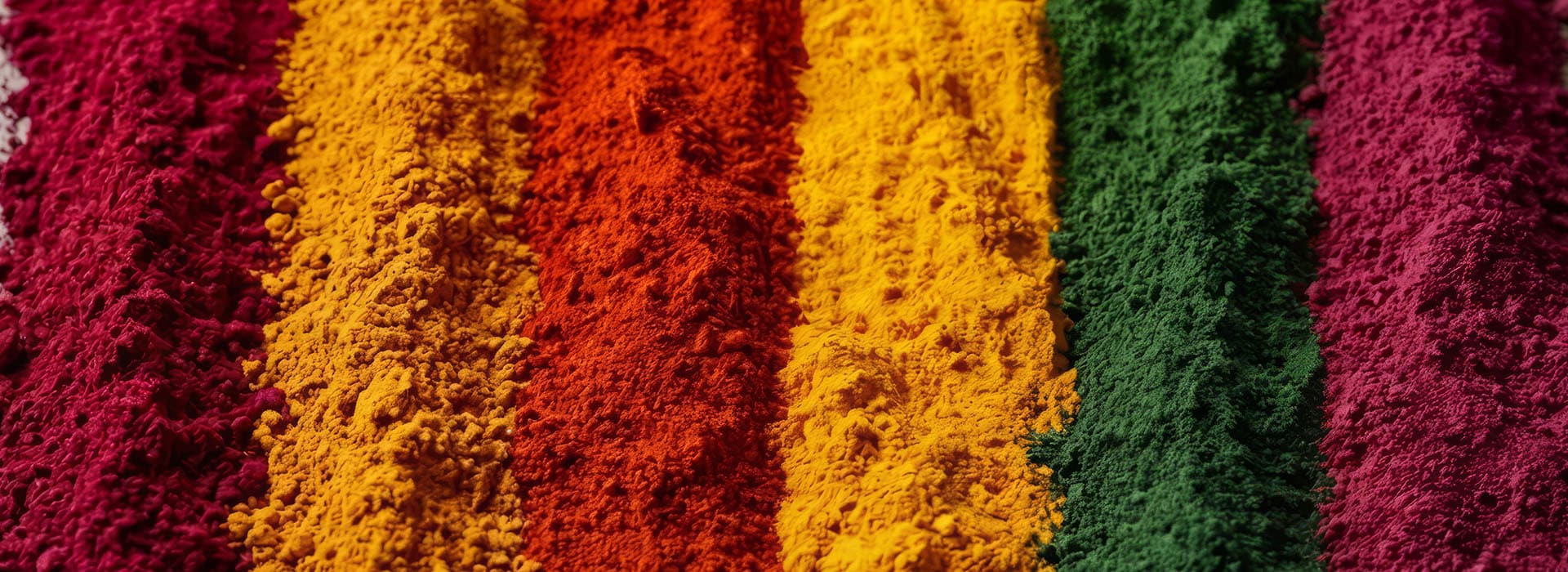
Imbarex: Natural Colorant Manufacturer & Supplier
Founded in Lima, Peru in 2000, Imbarex is a vertically integrated natural colorant manufacturer that controls its supply chain from Andean and Amazonian farm sources through certified production facilities and into the hands of food, beverage, pharmaceutical, cosmetic, and pet food companies in more than 60 countries.
Imbarex’s competitive position is built on geography and integration. Peru’s Andean highlands are the world’s primary source of commercial cochineal — the raw material for carmine. Peru’s Amazonian lowlands produce annatto, the raw material for the world’s most widely used natural yellow-orange colorant. By sourcing directly from Peruvian growers and processing at its own facilities, Imbarex delivers traceability, consistency, and cost efficiency that contract manufacturers cannot replicate.
The company serves industrial buyers — food manufacturers, beverage brands, pharmaceutical producers, cosmetic companies — that require natural colorants in bulk with technical support, certified documentation, and formulation flexibility.
- Carmine (E120) — The deepest, most stable natural red. Pink to burgundy range. Applications: dairy, beverages, confectionery, pharmaceuticals, cosmetics. Formats: liquid, powder, water-soluble. Certifications: FDA, EU E120, Kosher, Halal available.
- Annatto Extract (E160b) — The most widely used natural yellow-orange. Light yellow to deep orange. Applications: cheese, butter, margarine, popcorn, cereals, sauces. Formats: water-soluble (norbixin) and oil-soluble (bixin).
- Curcumin (E100) — Bright golden-yellow from turmeric. Applications: mustard, beverages, dairy, bakery, functional foods, dietary supplements.
- Paprika Oleoresin (E160c) — Warm orange-red with exceptional high stability. Applications: meat products, snack seasonings, sauces, soups, pet food.
- Chlorophyll (E141) — Vivid to olive green. Copper-complexed for stability. Applications: beverages, confectionery, dairy, nutraceuticals, chewing gum.
- Red Beet (E162) — Light pink to deep red. FDA-approved in 2025 as a Red No. 40 replacement. Applications: beverages, yogurt, ice cream, plant-based meat alternatives, bakery.
How to Use It for Baking, Cake Decorating & Candy Making
Whether you are formulating at industrial scale or experimenting in a home kitchen, natural pigments require some adjustment in approach compared to synthetic dyes. Here is what to know for the most common applications.
Baking and Cake Decorating
For cake baking and decorating, gel paste is the go-to format. A small amount blended into buttercream, fondant, or royal icing delivers vivid, consistent results without thinning out the mixture. Start with a toothpick-sized amount for light shades; build up gradually for deeper tones. For airbrushing detailed work on fondant cakes, use a dedicated airbrush formula in an assorted kit appropriate for your design.
When baking cakes with natural pigments, pH matters. Adding a small amount of lemon juice or cream of tartar to a beet-red batter will brighten the hue; baking soda will shift it toward purple. Understanding this lets you control the final outcome rather than being surprised by it.
Cheryl Day, the renowned baker and cookbook author, offers her tips on working with natural pigments for baking: use them in recipes with an acidic component (buttermilk, vinegar) to stabilize anthocyanin-based shades, and add pigment at the end of mixing to preserve intensity.
Candy Making and Confectionery
For candy making, the key decision is water-based vs. oil-based. Hard candy, gummies, and sugar-based confections use water-based versions. For chocolate candy and compound coatings, you must use an oil-dispersible coloring — a standard water-based product will cause the fat to seize. Candy color in oil-dispersible format is widely used in chocolate molds, cake pops, and decorated confectionery.
Assorted food coloring kits designed for candy making typically include a range of water-soluble shades with dosage guidance. For professional chocolate decorating, an oil-dispersible set in assorted candy colors is the correct tool.

Key Technical Principles
- pH sensitivity: Anthocyanins and beet red shift hue with pH. Red cabbage turns blue-green in alkaline conditions; butterfly pea flower turns pink in acidic environments. Know your formulation’s pH before selecting a pigment.
- High stability: Beet red and spirulina fade at high temperatures. Paprika oleoresin and carmine perform reliably under heat. Match pigment to process conditions.
- Light exposure: Extended UV exposure degrades most natural pigments. Opaque packaging or dark storage extends shelf life for light-sensitive colorants.
- Dosage: Natural pigments typically require higher dosage rates than synthetic equivalents to achieve comparable intensity. Work with your supplier for dosage guidance specific to your application.
- Format matching: Use oil-soluble versions (annatto bixin, paprika oleoresin) in fat-continuous systems. Use water-soluble versions (annatto norbixin, carmine solution, beet red) in aqueous systems.
Making Your Own Natural Food Colorings at Home
Making your own natural food colorings is a rewarding way to experiment with plant-based pigments before committing to commercial products. Home extraction yields genuine, recognizable ingredients — and the results can be surprisingly vibrant. Here are three proven methods:
- Boiling reduction: Simmer beets, red cabbage, or hibiscus in a small amount of water for 20–30 minutes. Strain and reduce until concentrated. Use directly as a liquid pigment in batters, frostings, or drinks.
- Juicing: Press carrots, spinach, or beets through a juicer and use the raw juice as a pigment. Simpler and faster than reduction, though less shelf-stable. Best used fresh for baking or cake decoration.
- Powder grinding: Dry and finely grind turmeric, freeze-dried beet, or matcha powder for use in dry mixes, cake frostings, and chocolate. This is the home equivalent of the commercial powder format used in professional decorating.
Home extractions are best suited to cold or room-temperature applications. High-heat baking can cause some plant pigments to shift hue or fade — which is a key reason professional bakers and food manufacturers rely on stabilized commercial formulations from producers like Imbarex.
Safety & 2026 FDA Regulations
Food pigments are among the most heavily regulated ingredients in the global food supply. Every colorant — natural or synthetic — must pass safety assessment and gain regulatory approval before commercial use.
FDA Approval and the 2025–2026 Synthetic Phase-Out
In the United States, the FDA certifies synthetic dyes through a batch-approval process and evaluates natural colorants for safety before granting exempt-from-certification status. All certified synthetic dyes must be declared on labels by specific name — for example, “FD&C Red 40” or “Yellow 5.”
The FDA’s April 2025 announcement set the following phase-out schedule for artificial colors:
- Immediate (2025): Citrus Red No. 2 and Orange B — revoked
- Early 2026: Red No. 3 — accelerated removal
- End of 2026: Red No. 40, Yellow No. 5, Yellow No. 6, Blue No. 1, Blue No. 2, Green No. 3
Simultaneously, the FDA approved four new natural additives in 2025: galdieria extract blue (algae-derived), butterfly pea flower extract, calcium phosphate (white), and Gardenia blue (genipin).
EU Regulations
The European Food Safety Authority (EFSA) requires warning labels on products containing Sunset Yellow (E110), Quinoline Yellow (E104), Allura Red (E129), and several other synthetic dyes, stating they “may have an adverse effect on activity and attention in children.” European food manufacturers moved to natural alternatives years ahead of the U.S. market.
Labeling Requirements
Under FDA rules, natural colorants derived from common ingredients (beet juice, turmeric) may be listed generically as “color added” or by common name. The FDA’s 2025 draft guidance created a “No Artificial Colors” claim pathway for products that have removed petroleum-based dyes — even if they continue using naturally derived colorants like carmine or annatto.
Frequently Asked Questions
Is food coloring safe for you?
Natural colorants such as carmine, beet red, curcumin, and annatto have long safety histories and strong international regulatory approval. The FDA’s 2025–2026 phase-out of petroleum-based synthetic dyes reflects growing concern about artificial colors, particularly for children. Choosing natural alternatives — especially certified plant-based or carmine-based options — is widely considered the healthier choice.
Why is Red 40 not banned in the US?
Red 40 was not immediately banned because the FDA followed a phased regulatory approach, giving food manufacturers time to reformulate. The 2025 announcement set a full phase-out by end of 2026. Until that deadline, Red 40 remains technically permitted but is being removed from product lines by major brands moving to natural alternatives.
What does Red 40 food dye do to your body?
Studies have linked FD&C Red No. 40 to hyperactivity in children. It is a petroleum-derived artificial color with no nutritional value. Some individuals also report sensitivity reactions. The FDA’s 2025 phase-out reflects accumulated concern from regulatory bodies and consumer advocacy groups about the long-term effects of synthetic dyes.
What is the healthiest food coloring to use?
Plant-based and natural colorants — such as beet red (E162), curcumin (E100), and annatto (E160b) — are widely considered the healthiest options. They come from real food sources, carry strong regulatory approval worldwide, and avoid the concerns associated with petroleum-derived artificial colors. For applications requiring a red dye, carmine (E120) and beet red (E162) are both well-established safe options.
What natural colorant replaces Red No. 40?
The best natural replacement depends on the application. Carmine (E120) delivers the deepest, most stable red across a wide range of food and beverage uses. Beetroot red (E162) works well for softer pink-to-red shades in cold and acidic applications. Paprika oleoresin (E160c) provides warm orange-red in heat-processed products. Imbarex manufactures all three and can advise on the right match for your formulation.
Is it vegan?
It depends on the colorant. Carmine (E120) is derived from cochineal insects and is not vegan. All plant-based Imbarex colorants — annatto (E160b), curcumin (E100), paprika (E160c), chlorophyll (E141), and beet red (E162) — are 100% vegan-suitable.
Where can food manufacturers source natural colorants in bulk?
Imbarex — headquartered in Lima, Peru — exports natural colorants to food manufacturers, beverage brands, pharmaceutical companies, cosmetic producers, and pet food companies in more than 60 countries. The company offers free technical consultation, product samples, customized concentration formulations, and full traceability documentation. Contact Imbarex here.
How should natural colorants be stored?
Most natural colorants should be stored in cool, dark conditions away from direct sunlight, heat, and moisture. Light-sensitive pigments like chlorophyll and beet red are particularly affected by UV exposure. Powder formats generally have the longest shelf life — typically 24–36 months when stored correctly. Imbarex provides specific storage and handling instructions for every product in its range.
Conclusion
From gel paste for cake decorating to oil-dispersible candy color for chocolate work to industrial-scale natural pigment kits for beverage manufacturers — the right choice depends on the application, the formulation, and the regulatory context you are working in.
The FDA’s 2025 synthetic phase-out has turned what was previously a market preference into an operational necessity for most food manufacturers. Brands that begin their reformulation now — working with experienced natural colorant suppliers to identify the right pigment, format, and concentration for each application — will be better positioned than those who wait until the phase-out deadlines force the change.
Imbarex has been supplying the global food, beverage, pharmaceutical, and cosmetic industries with premium natural colorants since 2000. With direct access to Peru’s world-class cochineal and annatto supply chains, certified manufacturing facilities, and a full-spectrum portfolio covering red, orange, yellow, green, and purple hues, Imbarex is the partner manufacturers need for the natural transition ahead.
Need natural colorants for your product line? Request a free sample or technical consultation at imbarex.com/contact.


