 Skip to content

 English
 Español
 Português
 Deutsch
 Français
 Русский
 العربية
Red 40 is a synthetic azo dye made from petroleum-derived chemicals and used to give foods, drinks and medicines a bright cherry red. It is also called Allura Red AC, FD&C Red No. 40 and E129, and it is the most widely used red food dye in the United States.
What Is Red 40?
Red 40 dye belongs to the azo family, a group of synthetic colors built around a nitrogen-nitrogen double bond that absorbs blue-green light and reflects red. Its chemical name is disodium 6-hydroxy-5-[(2-methoxy-5-methyl-4-sulfophenyl)azo]-2-naphthalenesulfonate, and its formula is C₁₈H₁₄N₂Na₂O₈S₂. In practice, it is sold as a dark red powder or granules that dissolve easily in water.
Allied Chemical developed Allura Red AC in the late 1960s, and the FDA approved it for food in 1971. It replaced Red No. 2 (amaranth), which the US banned in 1976 after studies raised questions about its safety. The European Union lists the same molecule as E129. On a US label it appears as “Red 40,” “FD&C Red No. 40” or “Red 40 Lake.”
Manufacturers like it for three reasons that are easy to measure: it costs a fraction of most plant-based reds, it keeps its shade through baking and pasteurization, and every batch produces the same color. That consistency is also why replacing it takes work. If you want the short consumer version, see what Red 40 is.
How Red 40 Is Made
Red 40 is produced in a chemical plant through a classic two-part reaction called diazotization and azo coupling. The starting materials come from aromatic compounds refined from petroleum, such as toluene and naphthalene. No plant or animal ingredient is involved at any stage.

Step 1: Prepare the two intermediates
The process starts with two sulfonated aromatic chemicals. The first is cresidine sulfonic acid (4-amino-5-methoxy-2-methylbenzenesulfonic acid), made from p-cresidine. The second is 6-hydroxy-2-naphthalenesulfonic acid, known in the industry as Schaeffer’s acid. Both already carry the sulfonate groups that will make the final dye soluble in water.
Step 2: Diazotization
The cresidine sulfonic acid is dissolved in water with hydrochloric acid and cooled to around 0 to 5 °C. Sodium nitrite is added slowly, which turns the amine group into a diazonium salt. The low temperature matters: above roughly 10 °C, the diazonium salt starts to break down.
Step 3: Azo coupling
The cold diazonium solution is added to Schaeffer’s acid under alkaline conditions. The two molecules join through an azo bond (‑N=N‑), and the red color appears at this moment. Operators control pH and temperature closely, because small changes shift the shade or create unwanted byproducts.
Step 4: Isolation and purification
Sodium chloride is added to “salt out” the dye, which then precipitates as a solid. The solid is filtered, washed to remove salts and unreacted intermediates, and dried. Some producers also convert part of the dye into Red 40 Lake by binding it to aluminum hydroxide, which makes an insoluble version for coatings and fat-based products.
Step 5: Milling, testing and FDA batch certification
The dried dye is milled to a consistent particle size and tested for color strength, moisture and impurities. In the US, the specifications in 21 CFR 74.340 require at least 85% pure color and set limits for lead, arsenic, mercury and residual intermediates. Each batch must then be certified by the FDA before it can be sold for food use.
Is Red 40 Safe?
Regulators in the US and Europe consider Red 40 safe within set limits. Both the FDA and the European Food Safety Authority (EFSA) use an acceptable daily intake (ADI) of 7 mg per kilogram of body weight per day. For a child weighing 20 kg, that is 140 mg a day.
The main question is behavior in children. In 2007, a study from the University of Southampton published in The Lancet found that mixes of synthetic dyes, including Allura Red AC, combined with the preservative sodium benzoate increased hyperactivity in some children aged 3 and 8 to 9. EFSA reviewed the study and did not change the ADI, but the EU decided to require a warning label on foods containing E129 and five other dyes from July 2010: “may have an adverse effect on activity and attention in children.”
In 2021, California’s Office of Environmental Health Hazard Assessment concluded that synthetic food dyes can affect behavior in some children and that federal limits may not protect them enough. Some people also report hives or digestive discomfort after eating foods with Red 40, though these reactions are uncommon.
So, is Red 40 bad for you? For most adults, current evidence does not show harm at normal intake. For children who are sensitive to it, the evidence is strong enough that many parents choose to limit it. We cover the health debate in more detail in our guide to Allura Red AC health risks.
Red 40 Regulations (Updated October 2026)
Red 40 is not banned in the United States or the European Union. What has changed since 2025 is the pressure to replace it.
Federal level (US). In April 2025, the FDA and HHS announced a plan to remove petroleum-based dyes, including Red 40, from the national food supply by the end of 2026. The plan is voluntary: Red 40 remains authorized under 21 CFR 74.340, and no rule to revoke it has been proposed. Many large food companies have published their own dates to drop it. Separately, the FDA revoked the authorization of Red No. 3 in food, effective January 15, 2027.
State level (US). Several states passed their own laws:
- California: AB 2316 (2024) bans Red 40 and five other dyes from food served in public schools from December 31, 2027.
- West Virginia: HB 2354 (2025) has banned Red 40 in school meals since August 1, 2025. Its statewide ban on retail sales, planned for January 1, 2028, was blocked by a federal court in December 2025 and is under appeal.
- Texas: SB 314 (2025) removes Red 40 from school meals starting with the 2026–27 school year. SB 25 (2025) would require a warning label on products containing Red 40 and other listed ingredients, but its enforcement was blocked by a federal court in February 2026.
- Other states: Delaware, Tennessee, Iowa and Alaska, among others, have approved school restrictions that include Red 40.
European Union and UK. E129 is authorized under Regulation (EC) No 1333/2008 with the mandatory warning described above. Because of that label, most large brands in Europe and the UK already use plant or insect colors in products that still contain Red 40 in the US.
Foods and Drinks with Red 40
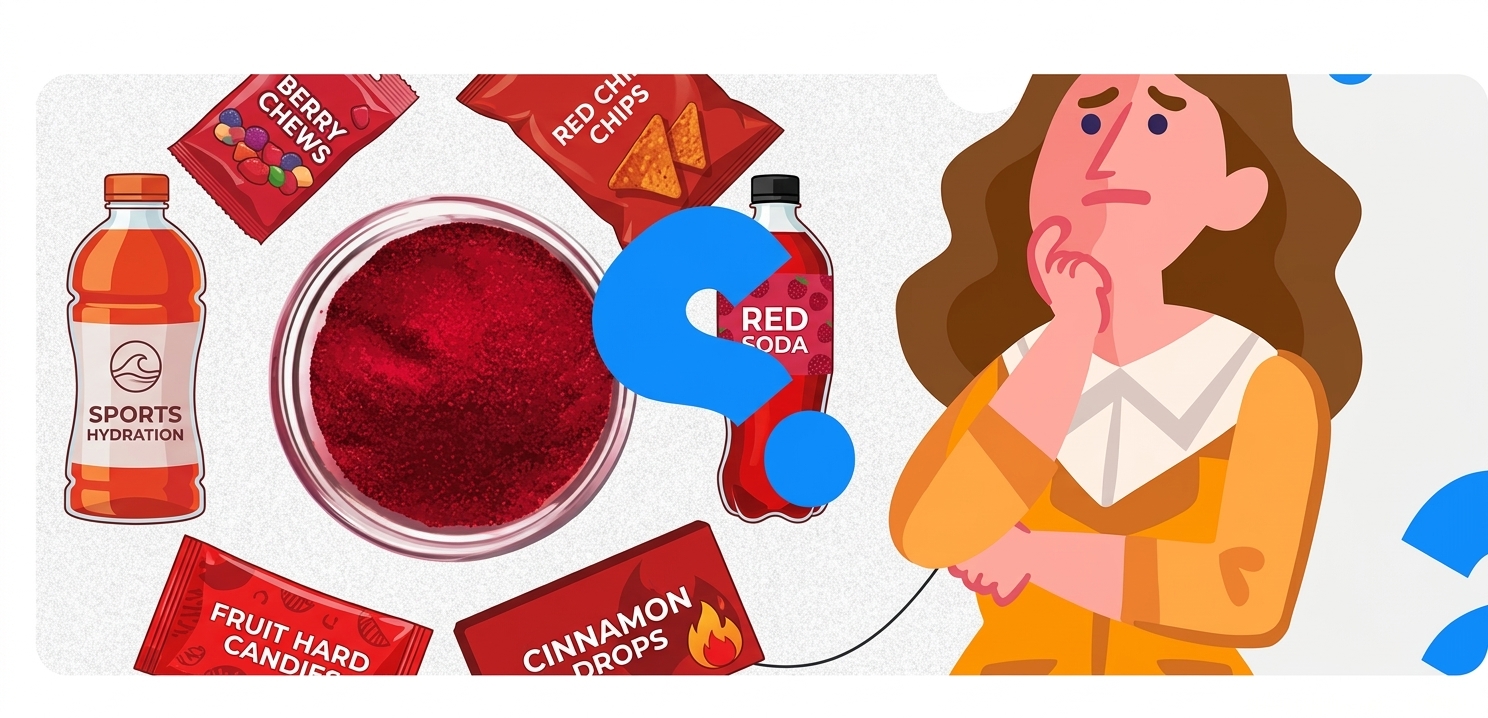
Red 40 is most common in products aimed at children: candy, gummies, fruit snacks, sports drinks, sodas, breakfast cereals, gelatin desserts, frosting and flavored yogurt. It also appears in some chips, sauces, syrups, chewable vitamins and cough medicines. It is often mixed with Yellow 5, Yellow 6 or Blue 1 to create orange, brown and purple shades.
For brand-by-brand lists, see our guide to sodas with Red 40. If you want to compare it with foods colored with cochineal instead, check our list of foods with carmine.
Natural Alternatives to Red 40 for Manufacturers
No single natural color replaces Red 40 in every product. The right choice depends on pH, heat, light exposure and whether the base is water or fat.
| Natural color | Shade | Best for | Limitation |
| Carmine / cochineal (E120) | Deep red to pink | Meat products, dairy, fillings, coated candy | Not vegan, must be declared by name |
| Anthocyanins (E163) | Bright red at pH below 4 | Beverages, gummies, hard candy | Turns purple or blue at neutral pH |
| Beet red (E162) | Pink to raspberry | Yogurt, ice cream, frozen desserts | Turns brown with long baking |
| Paprika (E160c) | Orange red | Snacks, sauces, seasonings, meat | Fades under strong light |
Carmine is the closest match to Red 40 in stability: it holds up to heat, light and processing better than most plant-based reds. Our carmine guide explains its forms and uses, and you can compare formats on our carmine product page. For acidic drinks and candy, anthocyanins from black carrot or purple sweet potato are the usual swap. Beet red works in chilled products, and paprika oleoresin in savory foods.
When you buy any color in bulk, ask your supplier for a Certificate of Analysis, specifications for color strength and heavy metals, and the regulatory documents your markets require. Imbarex has produced natural colors in Peru since 2000 and supplies food, beverage and cosmetic companies in more than 60 countries. See our options as a Red 40 alternative manufacturer.
Request a sample matched to your pH, process and target shade.
Frequently Asked Questions
Is Red 40 banned in Europe? No. Red 40 is authorized in the EU as E129, but foods that contain it must carry a warning about activity and attention in children. Because of that label, most European brands use natural colors instead. More detail in is Red 40 banned in Europe.
Is Red 40 vegan? Red 40 is made from petroleum-derived chemicals and contains no animal ingredients, so it is technically vegan. Some vegans avoid it because it has been tested on animals.
Is Red 40 halal? Red 40 is synthetic and does not come from animals or alcohol, so it is generally considered halal. Certification still depends on the full product and its processing. See is Red 40 halal.
What is the difference between Red 40 and Red 3? Both are synthetic red dyes, but Red 3 (erythrosine) contains iodine and gives a pinker shade. The FDA revoked Red 3 for food use from January 2027 after studies linked it to thyroid tumors in male rats. Red 40 remains authorized. Read our comparison of Red 3 vs Red 40.
What is the difference between Red 40 and carmine? Red 40 is synthetic and made from petroleum-based chemicals. Carmine is a natural color obtained from the cochineal insect. Carmine is more expensive but suits clean label products. See the full Red 40 vs carmine comparison.


