Skip to content


 English
 Español
 Português
 Deutsch
 Français
 Русский
 العربية
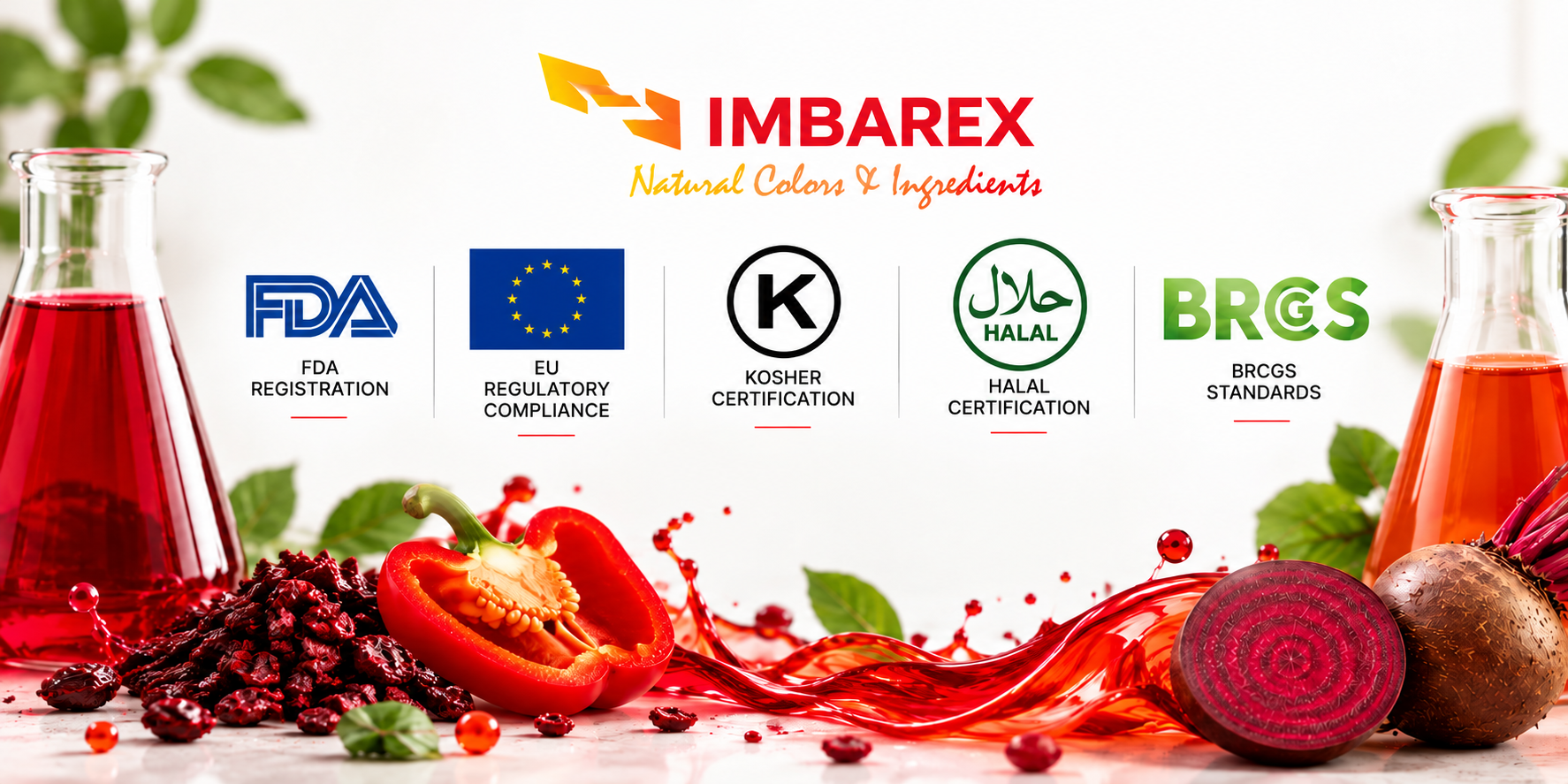
Imbarex supplies natural red food color for food manufacturers worldwide. Our range includes Carmine E120 (crimson-red, pH stable 4-7), Paprika Oleoresin E160c (orange-red, 100% vegan, heat-stable to 180°C) and Beetroot E162 (pink-red, 100% vegan). All FDA approved, EU certified, Kosher and Halal. MOQ from 25 kg.
For buyers searching for natural food colour red, the right option depends on the target shade, application and processing conditions. This guide compares three standardized colorants for professional formulations and explains what manufacturers should check before selecting a supplier. However, source, solubility, pH, temperature and labeling requirements mean the products are not interchangeable. Therefore, match each ingredient to the product matrix and required shade.
What Is Natural Food Coloring?
A colorant can create or enhance red, crimson, orange-red or pink-red shades in a finished product.
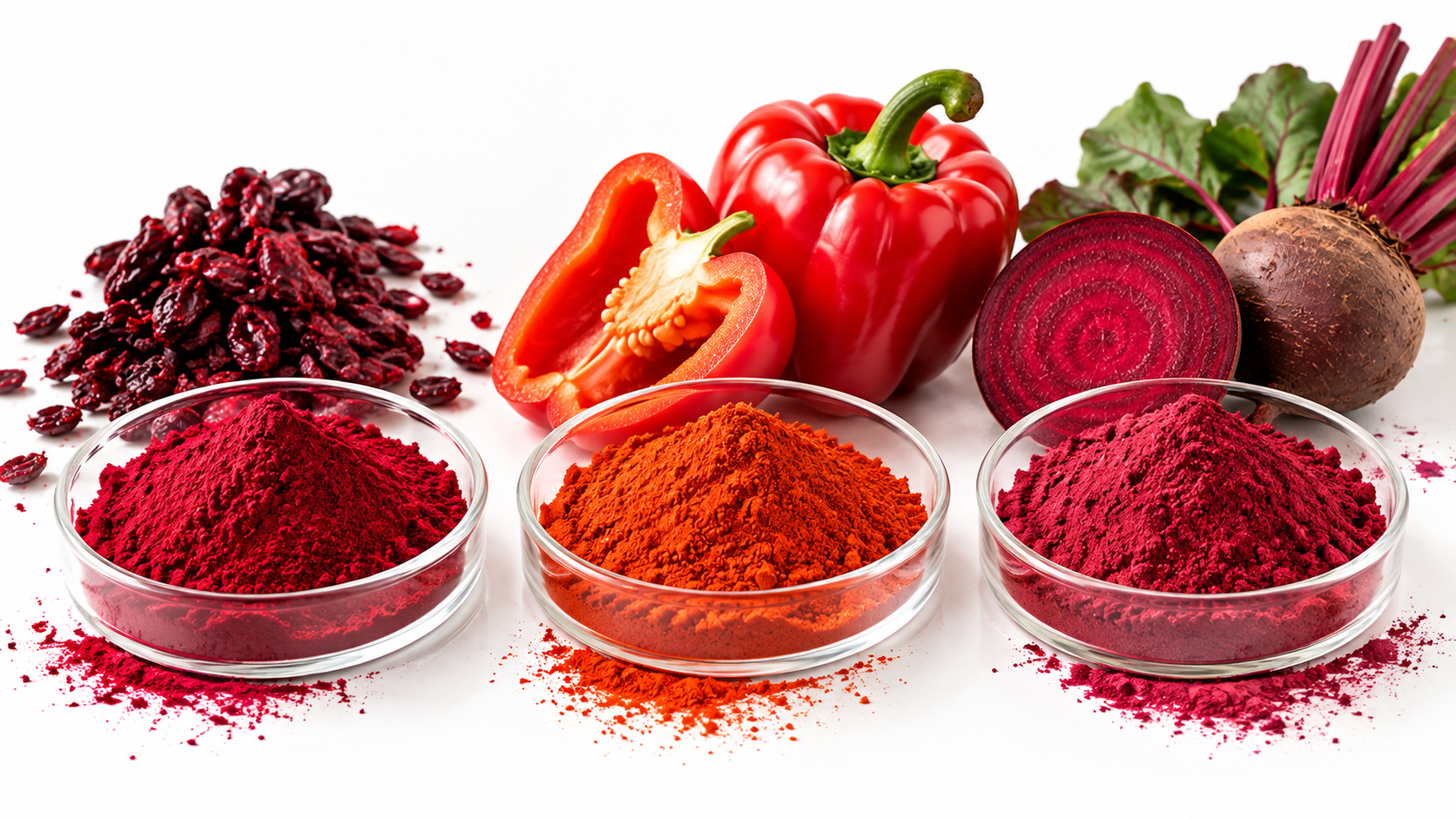
Carmine comes from cochineal insects, while paprika oleoresin and beetroot are plant-derived. These differences matter to manufacturers evaluating ingredient origin, product positioning and vegan requirements.
Searches for natural red colour for food can refer to commercial ingredients or home-made preparations. For example, people may use juices from red peppers, beetroot, hibiscus, annatto, carrots, oranges, saffron and tomatoes as coloring sources. However, these home preparations do not replace standardized industrial ingredients. For manufacturing, confirm ingredient identity, color strength, specification and permitted use before choosing a substitute. In addition, test commercial food coloring ingredients in the intended product instead of judging them by a dry sample alone.
Sources, Shades and Applications
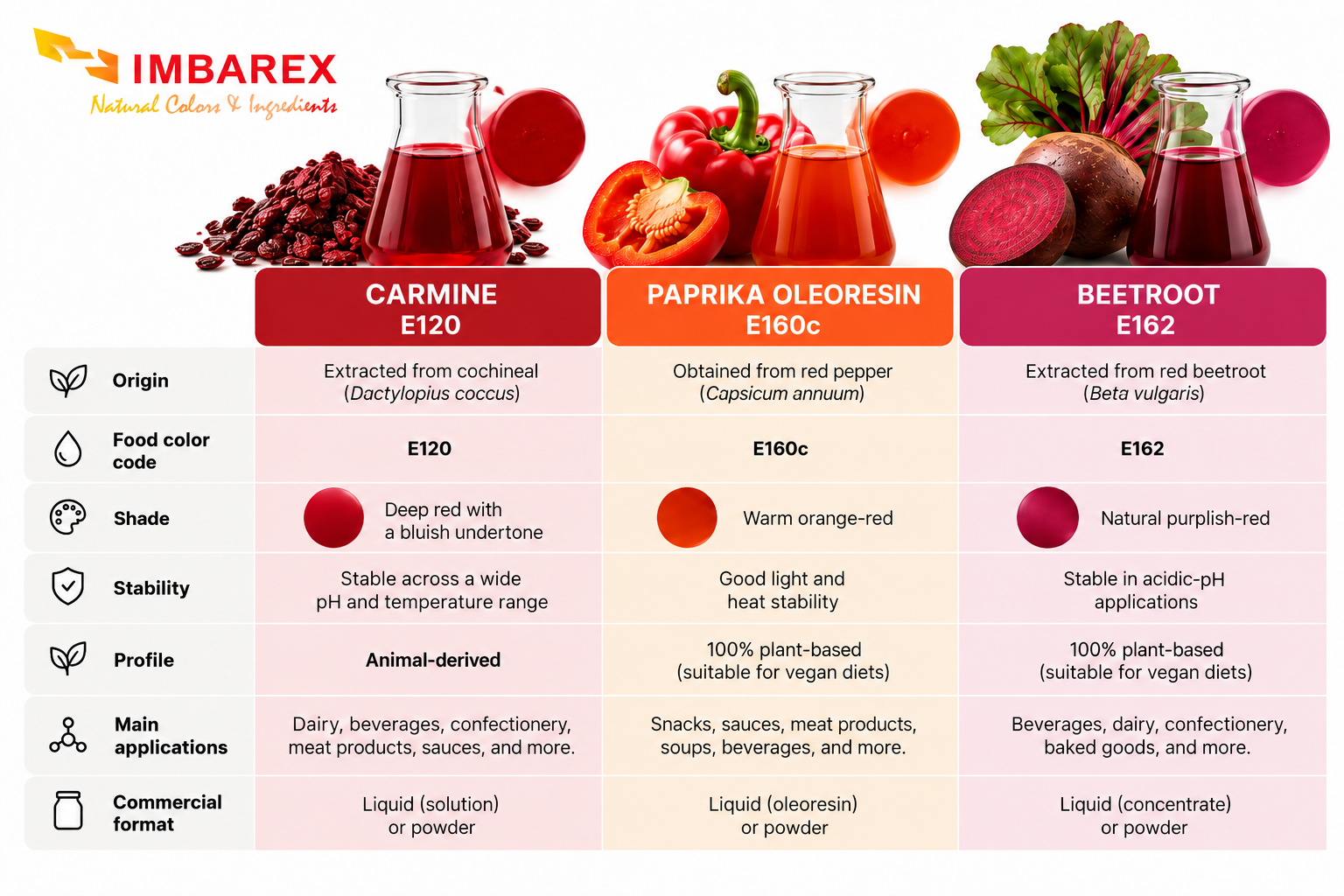
| Feature | Carmine E120 | Paprika Oleoresin E160c | Beetroot E162 |
|---|---|---|---|
| Source | Cochineal insects (Dactylopius coccus) | Red pepper (Capsicum annuum) | Beetroot (Beta vulgaris) |
| Shade | Crimson red | Orange-red | Pink-red |
| Vegan profile | No; insect-derived | Plant-derived; described in the brief as 100% vegan | Plant-derived; described in the brief as 100% vegan |
| pH stability | Stable within pH 4–7, according to the product brief | Confirm for the specific formulation | Check under the intended processing conditions |
| Heat considerations | Test in the actual process | Heat-stable up to 180°C under the stated application conditions | Evaluate heat exposure and storage stability |
| Potential applications | Meat products, dairy and compatible formulations | Snacks, seasonings, sauces and orange-red products | Plant-based foods and pink-red shades |
Use this comparison as a starting point rather than a substitute for testing. Review the technical data sheet and assess dosage, shade, solubility or dispersion, pH response and compatibility with the full formulation. You can also read about natural food coloring options containing Carmine E120 for industrial food applications when evaluating the ingredient for a particular application.
Carmine E120 — Industrial Applications
Carmine E120 comes from cochineal insects and provides intense crimson shades.
The product range described in the brief is stable within a pH range of 4–7.
Manufacturers can evaluate it for compatible meat and dairy products, subject to intended use and applicable regulations.
Industrial food coloring selection: For industrial production, select a format that suits the food matrix and equipment. For example, a soluble form may work well in some beverages, whereas manufacturers may prefer a lake pigment for applications such as processed meat. In either case, base the choice on the product, target shade, processing conditions and the manufacturer’s technical specification.
If the process includes pasteurization or heating, test the colorant under actual production conditions. As a reference point specified in the brief, evaluate pasteurization at 72°C for 15 seconds.
Because results vary with formulation, temperature and exposure time, test before scaling up. Imbarex supplies food manufacturers in more than 80 countries.
Carmine is not suitable for vegan products because it is insect-derived. Ingredient declarations must follow the labeling rules in the destination market. For product details, visit our page about Carmine E120 supplier for natural food colorant and red food coloring applications.
Vegan Options: Paprika and Beetroot
Manufacturers who cannot use an insect-derived colorant can evaluate Paprika Oleoresin E160c and Beetroot E162.
Both options come from plants, but they produce different shades and may respond differently to light, oxygen, heat and pH. Therefore, test each one in the finished formulation instead of judging its suitability from a sample alone.
Paprika Oleoresin E160c
Paprika oleoresin comes from red pepper and provides shades ranging from reddish orange to orange-red. According to the product brief, it remains heat-stable up to 180°C, depending on application conditions. Manufacturers can evaluate it for snacks, seasonings, sauces and other products that need an orange-red shade. To learn more about its uses, visit plant-derived Paprika Oleoresin E160c for food coloring and orange-red formulations, and test the finished product to check the effect of the food matrix and heating time.
Beetroot E162
Beetroot E162 can provide soft pink or pink-red shades.
Test it in plant-based products, selected dairy applications and other compatible formulations. Check heat, light, oxygen and pH effects during processing and storage.
In short, there is no single winner for every application.
Overall, carmine can suit crimson shades and compatible formulations. By contrast, paprika oleoresin offers a plant-derived option for orange-red tones, while beetroot works as an option when manufacturers need pink-red shades.
Choose according to the product, process, labeling and destination-market requirements.
How to Choose a Colorant for Your Application
Start with the food category, target shade and processing conditions. Use the table as a shortlist, not a replacement for technical or regulatory review.
| Application | Colorant to evaluate | Why it may be considered |
|---|---|---|
| Sausages and meat products | Carmine E120; a lake format where appropriate | May provide intense crimson shades in compatible formulations |
| Beverages | Carmine E120 in a suitable soluble or dispersible format | Requires evaluation of dispersion and stability at the beverage pH |
| Snacks and savory products | Paprika Oleoresin E160c | Can provide orange-red shades; assess heat exposure |
| Plant-based yogurt | Beetroot E162 | May provide a pink-red shade where compatible with the product matrix |
| Vegan formulations | Paprika E160c or Beetroot E162 | Plant-derived options; verify the full ingredient composition |
For example, a beverage colorant needs to disperse properly and remain stable under the formulation’s pH conditions. In meat products, the chosen format can also affect color distribution.
For snacks, evaluate heat exposure and the carrier system. Finally, test a sample in the actual product to compare color strength, dosage, flavor impact and storage performance.
Formulation and Stability Checks
Test Before Scaling Up
Evaluate the colorant in the intended food matrix, not only in water or a laboratory sample.
Acidity, temperature, light, oxygen, sugars and other ingredients may affect appearance. Record dosage, processing time and storage conditions to compare trial results consistently.
Food coloring ingredients: For a commercial ingredient, check color strength, solubility or dispersibility, compatibility with production equipment, shelf-life performance and supplier documentation. These checks help manufacturers compare natural food colorants with synthetic alternatives. In addition, consider flavor impact where relevant, and verify the identity and specification of beet powder or other vegetable-derived ingredients before making product claims.
Applications by Industry
Match the Ingredient to the Product
- Meat and sausages: evaluate Carmine E120 or a suitable lake format for compatible formulations.
- Beverages: test a suitable soluble or dispersible format and check pH stability.
- Dairy products: compare the target shade with acidity and processing conditions.
- Plant-based yogurt: consider Beetroot E162 when manufacturers need a pink-red shade.
- Snacks and seasonings: evaluate Paprika Oleoresin E160c for orange-red tones and heat exposure.
- Sauces and confectionery: assess dispersion, dosage and color retention through processing and storage.
These are starting points, not universal recommendations. Therefore, confirm suitability using the technical data sheet and finished-product conditions.
What to Check Before Buying in Bulk
Specifications and Supplier Documentation
- Technical specification: check the shade, concentration, stability and recommended use.
- Formulation compatibility: evaluate pH, temperature, ingredients and processing conditions.
- Regulatory status: confirm that local rules permit the ingredient for the food category and destination market.
- Certifications: request current documents supporting relevant halal, kosher or vegan claims.
- Minimum order and samples: confirm the minimum order quantity, lead times and sample availability before purchase.
Regulatory and Quality Requirements
In the United States, review applicable FDA requirements, including 21 CFR 73.100 and 21 CFR 73.345 where relevant to the specific colorant.
In the European Union, check Regulation (EC) No 1333/2008 and its amendments for the intended use.
Local requirements in Peru, Mexico, Spain and other markets may differ, so verify the rules that apply to the country where the finished product will be sold.
Moreover, confirm permitted use for the food category instead of relying on general claims about natural dyes.
Allura Red AC (E129 in the EU and Red 40 in the United States) is a synthetic colorant, unlike the natural ingredients compared here.
Therefore, compare natural colorants with artificial dyes by application, performance, labeling and applicable regulations, not source alone.
Imbarex: A Supplier for Food Manufacturers
Imbarex manufactures natural colorants in Lima, Peru, and supplies food manufacturers in international markets.
Its range includes Carmine E120, Paprika Oleoresin E160c and Beetroot E162, allowing buyers to compare an insect-derived crimson colorant with plant-derived orange-red and pink-red options.
The minimum order quantity is 25 kg, and free samples are available for evaluation.
Contact the sales team to confirm available formats, technical data sheets, product availability and lead times. Testing samples before production helps verify shade, processing and labeling suitability.
Frequently Asked Questions
Which colorant is best for a red shade?
The best choice depends on the application. Carmine E120 may suit products that need stability within a pH range of 4–7. Meanwhile, manufacturers can evaluate Paprika E160c for vegan applications.
Are these colorants safe?
Food colors must comply with the rules in the market where the product is sold.
Check the applicable FDA requirements (including 21 CFR 73.100 / 73.345 where relevant) and EU requirements for E120, E160c and E162 and the intended food category.
Are these colorants vegan?
Carmine E120 is not vegan because it comes from cochineal insects. In contrast, Paprika E160c and Beetroot E162 come from plants and the brief describes both as 100% vegan.
What is the difference between carmine and Red 40?
Carmine E120 is a natural, insect-derived colorant, while Red 40 (Allura Red AC) is synthetic. Their uses and labeling requirements differ by market.
Where can I buy colorants in bulk?
Imbarex supplies Carmine E120, Paprika Oleoresin E160c and Beetroot E162 from Lima, Peru. The minimum order quantity is 25 kg, and free samples are available.